
Blog / Lawyer

Thurgood Marshall Paved the Way for Judicial Diversity

justice thurgood marshall united states supreme court historic

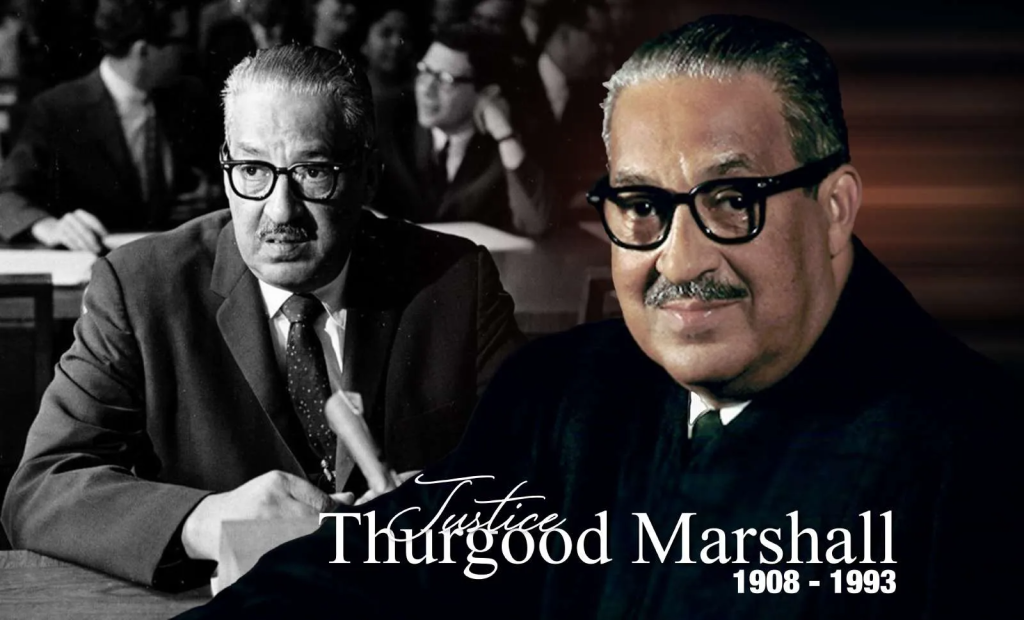
In the coming days, President Biden will nominate a black female justice to the Supreme Court. In honor of his historic decision, King Law Firm celebrates Black History Month with a look back at the first black Supreme Court Justice to grace the bench, the honorable Justice Thurgood Marshall.

Who is Thurgood Marshall?

Thurgood Marshall was born July 2, 1908 in Baltimore, Maryland to blue-collar workers William and Norma. Together, they instilled in Marshall a deep love of the Constitution and the rule of law. Marshall’s father fostered the young man’s debate skills by challenging his logic and forcing him to prove his beliefs whenever possible. He would also take him to view court cases on a regular basis.

Marshall graduated cum laude from Lincoln University in 1930 with degrees in American literature and philosophy. He went on to study at Howard University School of Law, graduating magna cum laude in 1933.

Shortly thereafter he built his own private practice in his hometown of Baltimore. In 1934, Marshall began his long affiliation with the National Association for the Advancement of Colored People (NAACP), setting the building blocks for his historic future.

Marshall’s Accomplishments

  • Founded and was Chief Counsel for the NAACP Legal Defense and Educational Fund.
  • Argued before the U.S. Supreme Court on many civil rights cases, winning 29 out of 32 cases. This included the successful argument in Brown v. Board of Education, which ruled segregation in schools as unconstitutional because “separate but equal” could not truly be equal in public education.
  • Was appointed to the United States Second Circuit Court of Appeals by John F. Kennedy, a position he held for four years.
  • Became the first black man to be appointed as the Solicitor General of the United States, winning 14 of 19 cases during his tenure.

Supreme Court

Happy with his performance as Solicitor General, President Lyndon B. Johnson nominated Marshall to the United States Supreme Court in 1967. He was confirmed by the Senate on August 30 of that year, officially making him the first black man to be appointed to the highest court in the United States. He would go on to build a storied record supporting the protection of individual rights of the most vulnerable Americans until his retirement in 1991. He would die of heart failure two years later.

Marshall paved the way for the court to begin to diversify. Before his nomination, the Supreme Court had been ruled by white males. Today, there are two persons of color and three female justices sitting on the Supreme Court. Pending confirmation, this will again change in the next few weeks, all thanks to Marshall’s tenacity and passion for individual rights and the path he laid for those to follow.


The legal system can force open doors, and sometimes-even knock down walls, but it cannot build bridges. That job belongs to you and me. The country can’t do it. Afro and White, rich and poor, educated and illiterate, our fates are bound together. We can run from each other, but we cannot escape each other.” – Thurgood Marshall



Posted in:

Related Posts

Litigation courtroom behind judge

The Advantages and Disadvantages of Litigation

Litigation may seem exciting on television: someone gets served, they run to an attorney, things get dramatic as both sides introduce explosive new evidence, and 45 minutes later, new information suddenly arises that helps win the case. Everything goes back to normal. Unfortunately, litigation in the real world rarely happens that smoothly. Litigation is a stressful process that could take days, months, or in some cases, years to complete. Most people would much rather settle out of court as quickly as possible. And though this may work well in some cases, no matter how stressful it may seem, litigation can be advantageous, even necessary at times, to preserve your rights. Advantages of Litigation Firm Resolutions: Many disputes cannot be resolved through alternative dispute resolutions (ADR). Litigation provides a clear outcome in a public forum, so even though each party may feel they are in the right, a judge will use facts and evidence to determine a clear resolution. Sets Precedent: If you believe a lawsuit may repeat itself over time, having a defined resolution will help to fight similar claims in the future. It can also help effect change by setting precedent for others who may find themselves in the same situation. Stricter Evidence Guidelines: During ADR, evidentiary power is usually in the hands of the arbiter, so biases can become an issue. Courts, on the other hand, have much stricter rules when it comes to how evidence is collected and presented. Litigation also helps force the hand of those unwilling to provide requested evidence with court-mandated guidelines and penalties for non-compliance. Appeals: Should you feel a mistake was made or the court was in some way biased against you during your case, you have the right to appeal the case to be heard in a higher court. In ADR, results are generally final, no matter what happens. Disadvantages of Litigation Time Consumption: As previously mentioned, court hearings take time. With all the myriad of lawsuits being filed every day, there isn’t enough time to hear them all in a timely manner. It could take months to simply get your case in front of a judge. Stressful: As you wait to get this dreadful monkey off your back, the stress of the situation can weigh heavily on your mind, causing you to lose a step-in business and in life, which could lead to additional problems. Damaging Relationships: Litigation can be emotionally draining and effect your relationships in a negative way. Distraction can lead to ignoring immediate family members or picking fights with close friends and relatives. Neutral Benefits Costs: Although litigation can become somewhat expensive, and there’s no guarantee you will be able to recover all your legal fees should you win, some litigation can be cheaper than going through ADR. Before deciding on whether you should go to court or try something else first, speak to an attorney about what is best for your specific circumstance.

A lawyer is worth the investment

Is a Lawyer Worth the Investment?

With the advent of the Internet, the do-it-yourself market has grown exponentially. But having access to information that teaches you how to do almost anything, some things better left to the professionals. This is especially true when it comes to preparing legal documents, which can be very complicated, time consuming and costly if you don’t know what you’re doing. But what does a lawyer actually do for me? A lawyer is an advocate, advisor and counselor. They have spent multiple years developing the necessary skills and knowledge to best offer legal advice in all matters, including the preparation and filing of legal documents. Lawyers are ethically bound to uphold the law while protecting your rights, so having a licensed lawyer help form your business, draft a will or trust, review contracts, speak with city officials or send out correspondences will almost always save you time, money and aggravation, both now and in the future. What are the benefits of hiring a lawyer over using an online service like LegalZoom? LegalZoom, and other document preparing websites, are generic systems that allow you to draft basic documents like wills, living trusts and business formation. But LegalZoom claims on their website that “80 percent of people who fill in blank forms to create legal documents do so incorrectly.” So although it may be a cheap alternative to filing this type of paperwork, unless you’ve done hours of research beforehand, the chances of making a mistake are high. Filling out forms isn’t as easy as you may think. Simple statements may seem okay for you, but when it comes to the law, every word counts. Small mistakes or minor omissions can have big consequences. Lawyers understand the specific language necessary to make sure your documents are iron-clad and can hold up in a court of law. In fact, LegalZoom is not a law firm and their employees are not lawyers, so they cannot be held accountable for how you fill out your documents, nor can they offer legal advice or represent you in legal matters. A lawyer, on the other hand, must be held accountable and can be sued for malpractice if they file forms incorrectly or do not meet the ethical standards set up by the American Bar Association. Laws are also constantly in flux, and no one document fits the needs of every single person. Where documents on LegalZoom may be dated, Lawyers remain current on all state and federal laws and have the knowledge to know when and how to rewrite, alter or merge documents so as to better fit your needs. LegalZoom may be good for smaller, less consequential documents, but when it comes to forming a business or writing a will, nothing beats the knowledge or the experience of a good lawyer to make sure everything is prepared correctly from the start.

estate plan manipulation king law firm - King Law Firm Inc. 5 Estate Planning Red Flags

5 Estate Planning Red Flags

Planning for one’s death is important to avoid time consuming and often costly probate. However, creating a will or trust can be easily subject to undue influence. The client may not even know they are being manipulated. When the drafting of an estate plan begins, an ethical estate planning attorney will always be on the lookout for estate planning red flags that may hinder a person from signing, isn’t in their own best interest, or that will lead to costly or manipulated probate proceedings. 1. Medical or Cognitive Impairment The one key proponent for any legal document is the ability to sign under a sound mind. If after one’s death it’s discovered that the signer was not of sound mind when they signed the document, it could lead to costly litigation. When an individual drafts a will, always make sure they are not mentally impaired or living in a mental care facility. 2. Odd Changes After an estate plan is completed, large or irregular changes might prove that the signer is being manipulated into altering it. Changes that might raise a red flag include the disinheriting of a family member, adding someone out of the blue, or shifting major assets from one person to another. 3. Who Made the Appointment and Who is Making the Decisions It is always in the best interest of the person creating the will for that person to actively want to create the will on their own. If a family member, friend, intermediary, or nurse sets up the appointment and is making all the decisions for the signer, those decisions are probably not the true wishes of the signer. 4. The Creation and Signing is Being Rushed Creating an estate plan should not be an urgent matter. There are a lot of considerations to make that might be overlooked if the will or trust is rushed through the process. Family or friends who may be eager to get a will signed, refuse to answer questions for expediency, or are trying to rush the process in any way do not have the best interests of the signer in mind. 5. Property with Joint Tenancy is Encouraged Attempting to add assets into a will or trust that are jointly owned will do nothing but cause major issues during probate. Anyone pushing to include jointly owned property, such as a home, car, bank account, or even debt, may simply be looking to force a contention, which will lead to long, drawn-out and expensive probate hearing. One of the above estate planning red flags on its own probably isn’t enough to keep an ethical attorney from drafting a will. However, if multiple factors arise, the motivations behind the estate plan must be addressed to determine the client’s capacity to create and sign the document and guarantee the estate plan isn’t being created under undue influence.