
Blog / Wills

Blog

All Wills Family Law California Law Estate Planning - Wills, Trusts, and Probate Divorce Business Legal Documents Pop Culture Custody Probate Code Child Custody COVID-19 Conservatorship King Law Firm News Lawyer Guardianship Executor Legal Codes Litigation Arizona Law Holidays Marriage Beneficiary Featured Immigration Fiduciary Kentucky Law LGBT Nursing Home Neglect Realty Texas Law Trusts Undue Influence Adoption Annulment Awards Books Domestic Violence Expungement Fifth Amendment First Amendment Inflation Landlords Mergers & Acquisitions Mitigation Podcast Prenuptial Agreements Reverse Isolation Self-Incrimination Social Media Summary Dissolution Videos
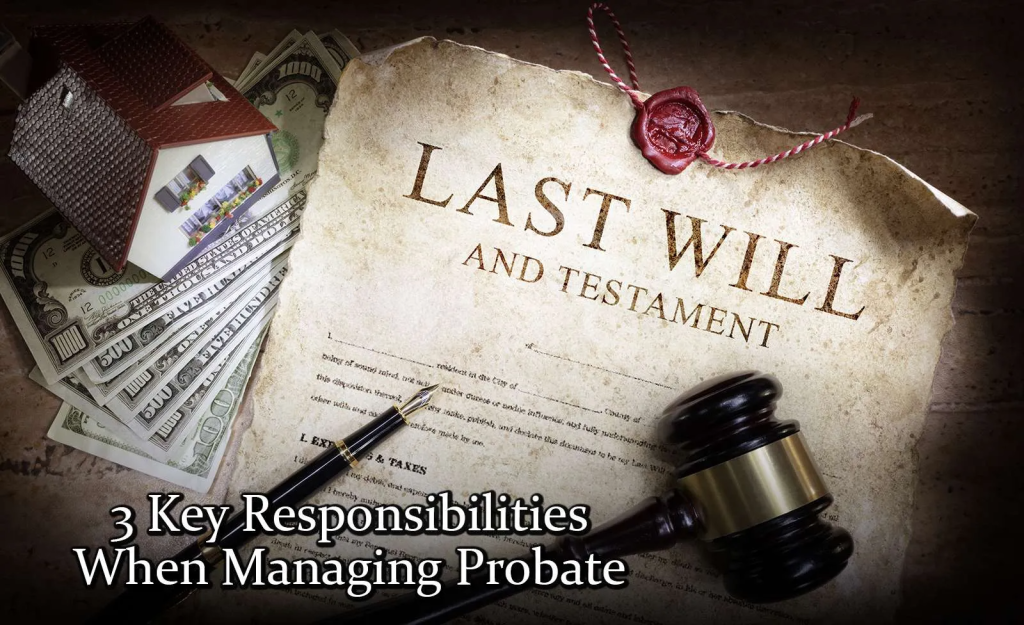
3 responsibilities of an executor for probate shows last will and testament

3 Key Responsibilities of an Executor When Managing Probate

When you agree to be the executor of a will, there are plenty of responsibilities you must take on. (See our 6-Step Process for Probate for more). Here, we break down the three key responsibilities of an executor when managing the probate of an estate. First, Collect the Assets. Collecting assets seems straightforward, but there is a lot to consider. Questions to ask when beginning the process: Does the decedent have real estate? Where are those documents kept? What bank accounts does the decedent have? Is the information readily available? Did the decedent invest in anything? What do those contracts entail? How much personal property does the decedent own? How will this all be distributed? Are the assets a part of joint tenancy or in a trust? (These items are not subject to probate.) As assets are collected, keep a comprehensive budget, ledger, and/or catalogue of everything. This includes all banking information, real estate deeds, bills, phone numbers, emails, and other real property. Stocks, titles, vehicles, and other legal documents must also be transferred into the name of the executor. During this process, a court-appointed probate referee will valuate all non-cash items with fair-market value. Then, Pay Off Debts. Once collected and catalogued, the executor must enumerate and pay all debts before anything can be distributed. This may include credit cards, loans, utilities, and other liabilities. Creditors may also make claims against the estate, usually within four months of appointment unless they were not aware of the death. Make sure to identify assets that are protected from creditors and be prepared for possible lawsuits should you reject a claim. Most debts, including funeral costs, are usually paid for by the estate. It’s sometimes necessary to sell assets to cover these debts, though insurance policies may cover certain debts as well. If assets do need to be sold, beneficiaries must be notified at least fifteen days before the sale and a court may get involved if there is a dispute or objection. Some assets, such as student loans or Medicaid benefits, may be transferred or forgiven depending on the lender, while others, such as stocks, bonds, or real estate, must get court approval before selling. Finally, Handle All Necessary Taxes. They say the only two guarantees in life are death and taxes. Unfortunately, the decedent isn’t immune to taxes after death. There are several federal and state taxes, estate taxes, sales taxes, gift taxes, pre-death income taxes, and fiduciary taxes that must be paid out of the estate before assets may be distributed to beneficiaries. Remember, laws and taxes change constantly so it might be better to reach out to a tax accountant to make sure all paperwork is filed correctly and laws are being adhered to. Insolvency If there are not enough assets to cover all debts, the executor must declare the estate insolvent by petitioning the court. If they fail to do so, the executor may be held personally liable for any taxes or debts that may still be owed.

money, gold, and a bag surrounding some wooden people representing beneficiary rights

5 Important Beneficiary Rights to Know

Screenshot A lot of things can happen when an executor or administrator of an estate begins the process of asset distribution—asset mismanagement, distribution delays, and lack of communication among them. As a beneficiary of a trust or an estate, you are entitled to certain rights. Knowing these beneficiary rights will help set appropriate boundaries and expectations, ensuring proper administration of the estate. Beneficiary Rights to Notification When a will is in place, you have a right to be notified when the will has been entered into probate, as well as the right to know who has been appointed to manage the estate. Beneficiary Rights to Information As a beneficiary, you have the right to always know what is happening with the estate. This means you have a right to receive copies of the will or trust, ask about your inheritance (and whether assets must be sold to pay off debts), and request periodic statements of account (including detailed reports on assets, liabilities, income, expenses, and requests for compensation). Beneficiary Rights to Timely Distribution & Fair Treatment Executors or administrators have a fiduciary duty to act in the best interest of the beneficiaries. Unless a will or trust says otherwise (and taking the complexity of the estate into consideration), completing probate or distribution of assets should not take years upon years, nor should it exhibit preferential treatment. As a beneficiary, you have the right to expect fair and unbiased asset distribution within a reasonable amount of time. In most states, this means up to twelve months. Beneficiary Rights to Contest a Will After a will has been entered into probate, you have the right to contest the will if you feel it was drafted through undue influence or fraud, especially if it was improperly witnessed or the designated signee lacked the mental capacity to know what they were signing. In most states, you have up to 120 days to contest the will once you are informed of probate. Beneficiary Rights to Hold Trustees Accountable and Remove an Executor At any point in time, if you feel an executor or administrator is mishandling the estate, you have a right to petition the court for a remedy, which may include suing the executor or administrator and asking for removal. Be careful, though, because the court will only remove an executor or administrator if you have a valid reason to believe they are managing the estate in bad faith. This may include stealing, selling property below market value, failing to keep records, or other acts of misconduct. Other valid reasons may include a lack of mental or physical capacity or conviction of a crime. What the court won’t do is remove an executer simply because you didn’t like a decision they made. For more information on your rights as a beneficiary and for real-life case studies, download Your Guide to Beneficiary Rights.

the cast of Knives Out standing distraught with a judge doing paperwork in the background

Contest a Will – How to Keep From Going "Knives Out"

Knives Out chronicles the mystery behind the death of affluent patriarch (Christopher Plummer). Hidden within Detective Benoit Blanc’s (Daniel Craig) investigation is a family in turmoil – not because of the death itself, but because of how he divided his grand estate in his last will and testament. When it’s discovered that the patriarch has left the entirety of his estate to his faithful nursemaid (Ana de Armes), his kids do whatever they can to convince her to give up the inheritance or steal it in extraordinary ways. This, of course, is not the best way to go about contesting a will. The Correct Way to Contest a Will If the statute of limitations for contesting a will hasn’t expired, you must first petition the probate court (sometimes called a caveat proceeding) evaluated for validity and grounds for contestation so as to invalidate the will and find another way to distribute the decedent’s assets. Keep in mind that contesting a will can be a complex and expensive endeavor (especially if you hire a probate attorney to make sure everything is properly executed), so verify you have all your ducks in a row before beginning the process. Who Can Contest a Will? There are two types of individuals that have standing to contest a will: Beneficiaries—legal adults specifically named in the will, whether it be a family member, friend, charity, or pet. Heirs—individuals who would have a claim on inheritance, such as immediate family, if there was no will upon the decedent’s death or the will was found to be invalid. When Is Contesting a Will a Valid Course of Action? Contesting a will is a valid course of action when you can prove that it was improperly executed. Some reasons why this happens is when: the person creating the will (the testator) didn’t have the mental capacity to understand the contents of the will. a caregiver, family member or friend coerced, manipulated, or pressured the testator into drafting or changing the will (also known as undue influence). Someone forged the testator’s signature. The will lacks the required number of signers, witnesses, and notarizations. There are copious amounts of conditions put on how the inheritance can be received. What Else Should I Look Out For When Contesting a Will? Check with your state and local laws for specific requirements. For instance, in California, family members are all considered interested parties, regardless of whether they are named in the will; and in Texas, individuals with no relationship to the testator may not contest the will. Some states will also accept no-contest clauses or hand-written notes for why assets were distributed in certain ways. Of course, if there is a no contest clause in the will, going Knives Out may be the only remedy. Before you reach that point, though, contact King Law Firm Attorneys at Law Inc. We are ready to fight for your rights and help you navigate the often complicated and time-consuming process. Learn more with Gavels Down, Voices Up - Episode 14: Inheritance Wars: Defending Your Rights and Navigating Contests Episode 5: Last Wills and Family Feuds: Navigating Estate Planning Waters Episode 25: The Messy Relationship Between Death, Divorce, and Your Estate Plan

Contact Us

Fill out this form below and we'll contact you shortly
*Required Fields