Blog / Divorce

Blog

All Divorce Family Law California Law Estate Planning - Wills, Trusts, and Probate Business Legal Documents Pop Culture Custody Probate Code Child Custody COVID-19 Conservatorship King Law Firm News Lawyer Guardianship Executor Legal Codes Litigation Arizona Law Holidays Marriage Beneficiary Featured Immigration Wills Fiduciary Kentucky Law LGBT Nursing Home Neglect Realty Texas Law Trusts Undue Influence Adoption Annulment Awards Books Domestic Violence Expungement Fifth Amendment First Amendment Inflation Landlords Mergers & Acquisitions Mitigation Podcast Prenuptial Agreements Reverse Isolation Self-Incrimination Social Media Summary Dissolution Videos
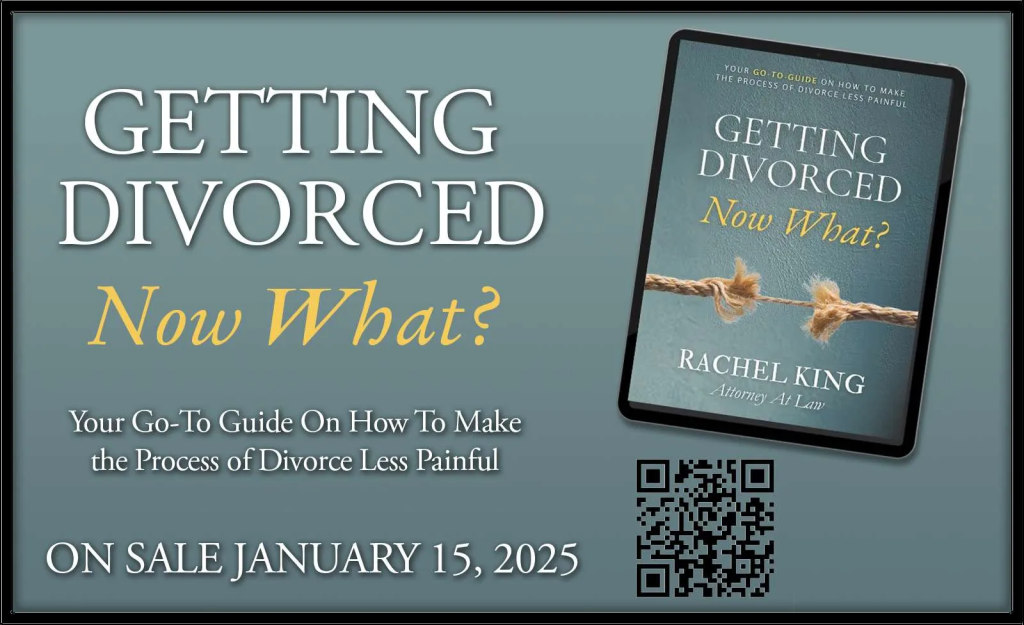
Getting Divorced... Now What? advertisement with book cover and QR code announcing sale on January 15, 2025

Getting Divorced… Now What? – Buy It January 15th, 2025

“When faced with the question of whether you should stay in a marriage, difficult emotions are bound to arise…. Despite the emotions involved, a life-changing decision needs to be made when considering the financial, emotional, and legal implications specific to your situation. The first question you should ask is: ‘Should I file for divorce or repair my marriage?’.” Thus begins Getting Divorced... Now What?, a new go-to guide on making the process of divorce less painful. Life And Expectations Change No one expects they will be heading for divorce when they say yes to a proposal from someone they deeply love. But life, growth, and experience inevitably change people, and if one’s spouse is unable to accept those changes, divorce also becomes inevitable. Whether the divorce is amicable or catches one party off-guard will determine how complicated and emotionally devastating this life-changing event becomes. Getting Divorce… Now What Written by family law and litigation attorney Rachel King, Getting Divorced... Now What? explores the many complexities of divorce. Her main goal in writing the book was to compile what she’s learned over ten years of representing and witnessing thousands of family court cases into a compassionate, relatable roadmap for those who may not be able afford an attorney. It provides the tools necessary for anyone contemplating divorce—or in the midst of one—to confidently navigate the rigors (emotional and legal) of divorce and simplify the complicated chapter of their life. Real-Life Stories One key element of Getting Divorced… Now What? are real-life anecdotes and stories that offer a sense of relief, letting them know that they are not going through their divorce alone. Here’s a quick excerpt of one story (names and facts have been altered to protect the individuals involved): “Meet Sarah and John: They live in the heart of a bustling city, amidst the chaotic rhythm of life. They married at 23 years old, right after college, deeply in love, and quickly started their family. Now, thirteen years later, life is taking its toll on their marriage…. She finds herself overwhelmed, and her marriage is feeling the brunt of it. She is torn between wanting to save the marriage, or realizing that maybe it's too late, and it’s time to move on. A lot has happened over fifteen years. She is exhausted and not sure if she is emotionally willing to invest another day in her marriage.…. Their journey began like a fairy tale, with stolen glances, and promises of forever. Yet, as time and life unfurled its complexities, cracks began to form in the once-solid foundation of their marriage. Sarah, with her heart heavy with burden, finds solace in the silent confinements of her therapist's office. Should she stay or should she go?” You Are Not Alone With many anecdotes, stories, and practical and authoritative information from Rachel King’s ten years of experience, by the time you’re done reading Getting Divorced… Now What?, you will no doubt believe “You are not alone, and you will survive!” Take your first step towards healing and empowerment by checking out a free chapter of Getting Divorced… Now What? And look for the book when it’s released on January 15, 2025. Get answers to all of your burning questions about Getting Divorced… Now What? Disclaimer: Getting Divorced… Now What? is not a replacement or substitute for legal advice. You should speak with an attorney in your jurisdiction to get legal advice on your case. The book is not legal advice and is not intended to be legal advice. The book is for informational and entertainment purposes only. Buying, reading, or otherwise using this book does not establish an attorney-client relationship, nor does it constitute legal advice.
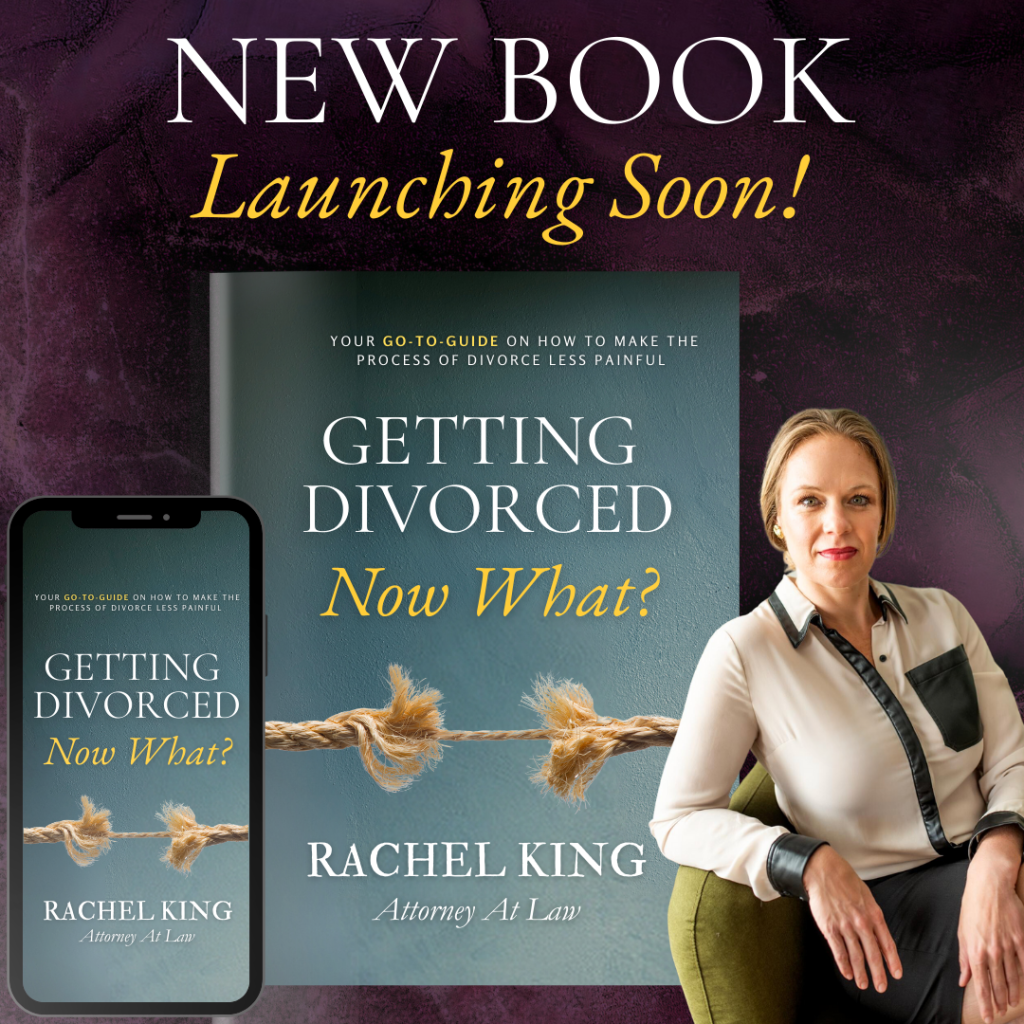
Rachel King Book Launching - King Law Firm Inc. Getting Divorced… Now What? A Q&A with Attorney Rachel King

Getting Divorced… Now What? A Q&A with Attorney Rachel King

Rachel King, lead litigation attorney at King Law Firm Attorneys at Law, Inc., has a new book being released soon. We talked to Rachel about the book, Getting Divorced... Now What? and the challenges one might face when representing themselves during divorce. 1. What is Getting Divorced… Now What? It is everything I have learned over a decade of practicing litigation. It is my attempt to share the inside scoop on divorce in a way that is helpful for individuals facing divorce, which includes case studies, general legal information, tips and tricks—all written without legalese. 2. What Inspired you to write the book? I found that the expectations clients have in a divorce vary hugely but are also unrealistic when compared to the law and are often driven by emotion. This can cause a person to get completely off track and make their case worse. I wanted to share a different perspective, one that many people never get (details attorneys feel are unpopular) attorneys feel the or have to pay a lot of money for (hiring their own attorney). 3. How did you choose the real-life stories included in the book? I’ve watched thousands of people in court—I’ve seen it all. So, I looked at a lot of common scenarios and tried to pick situations that are most likely to be encountered or that illustrate a specific issue in the best way. My goal is to share stories that show ‘you are not alone’ while bringing credibility to the information I am sharing. Of course, the real-life stories included in the book are only based on people and families; the details and the players in each one have been changed. 4. Do the stories offer a comprehensive look at the challenges faced during a divorce? I definitely had to balance comprehensive with taking people down the rabbit hole. (Believe me, I could have written an entire series—and maybe I will!) My goal is to be a helpful resource, not a law school course. Therefore, I focused on what I considered the most common issues, and concepts that are misunderstood, or unpopular realities that no one is talking about in divorce. 5. In your opinion, what is the most influential real-life story in the book? I love the stories that share empowerment. Divorce is hard. Showing that people can have a successful outcome through divorce is important; or maybe even better, can have a successful post-divorce life even if they lose. I really want to show people that the law is different than the dream. Understanding that early can make the process more tolerable. 6. What are some common misconceptions when representing yourself in a divorce? Hands down—that you get special treatment because you don’t’ have an attorney. Not the case. The court may be more patient, but you will be held to the same standards as the attorney sitting across the table from you. This is most difficult when it comes to presenting a case in trial and getting in evidence. 7. What are the top three mistakes people make when representing themselves in a divorce? Making decisions in their own case based on what happened to their friend. Not taking the time to understand the law. Thinking you get special treatment and that the court will let it slide just because you are representing yourself. 8. Does Getting Divorced… Now What? Help readers understand the financial implications of divorce, both during and after? There is definitely discussion about dividing assets, debts, and child and spousal support. Because, let’s face it, divorce causes financial upheaval. But fear not; this is not an economics class, and you don’t have to do math. 9. How can Getting Divorced… Now What? mentally prepare someone for divorce (and to represent themselves through the divorce)? It gives a global understanding of divorce, which can be used as a starting point when preparing for divorce, but it can also be used throughout the process to help focus and review your case so that you remember what you are fighting for. The reality is that goals are going to change throughout the process—and even after—so revisiting this can be very helpful. 10. What was your strategy for putting together the workbook that goes along with Getting Divorced… Now What? The amount of information needed in a divorce can be daunting. The goal of the workbook is to create a free space that can help organize information so that you can look at what the real issues are, what your goals are, and what the argument is. I wanted to provide a space that could be easily accessible and hopefully provide confidence in an otherwise overwhelming and paralyzing process. 11. What is the most surprising thing you learned while putting the book (and workbook) together? It is a lot of work! The biggest challenge was trying to include important and helpful information without it turning it into a dissertation or encyclopedia. It was very hard to say “OK Rachel. It is OK to stop now.” I could have gone on forever. 12. What is you’re the most important piece of advice you can give someone representing themselves in a divorce? Prepare properly. Properly being the operative word. Sign up to King Law Firm’s newsletter to get notified when Getting Divorced... Now What? goes on sale. For more on divorce, check out these posts: 5 Factors to Consider When Representing Yourself in a Divorce Summary Dissolution – Simplified Divorce in California California Divorce in 6 Simple Steps — A Primer

pro se - representing yourself in a divorce gold rings on top of a decree

5 Factors to Consider When Representing Yourself in a Divorce

Complexities aside, representing yourself in a divorce should always be a last resort. We understand not everyone can afford a high-priced attorney, but the inability to separate one’s emotions keeps a lot of people from logical, rational discourse, which inevitably leads to an outcome that’s skewed in the spouse’s favor. However, if you must act pro se (‘pro•say’; meaning to act as your own attorney), consider these five factors. 1. Do Your Research Not all online forms, do-it-yourself guides, and resources are created equal. If you choose to act pro se, do plenty of research into every facet of the process. Legal Terms: You will need to be familiar with many legalities throughout the process, the most important being ex parte (ex•par-tay) communications. These are unsolicited documents, calls, or visits with the judge or clerk, or communications that weren’t transmitted to the opposing attorney. Following the Law: Though some judges are more lenient when representing yourself, they still expect you to follow the law. Be aware of deadlines, courtroom etiquette, correct filing, and rules of evidence. Claiming you didn’t know is never a viable excuse. Communicate: Failing to meet deadlines or respond to paperwork, will always be your fault and may result in a default judgement. Make sure the court, administrator, and spouse’s attorney all have your most recent home address and a professional email account. 2. Custody and Property Representing yourself poorly may affect custody, visitation, support, and property received. Custody: It’s important to know the difference between physical and legal custody, and sole vs. joint custody. You should also understand that agreeing to custody arrangements without considering modification could keep you from changing them in the future. Property Division: It may seem easy enough, but real property has a lot of unknown secrets. For example: if you take your name off the title of your home but not the mortgage, you may still be responsible for payments should your spouse fail to pay. Take this into account for credit card debt and car loans as well. 3. Accessing documents from your spouse How do you subpoena documents? Not knowing how or what documents to collect could lead to mishandled evidence, late filings, and incomplete paperwork. 4. Stay Away from Social Media Social media during a divorce is not your friend. Every post you make, no matter if it’s hidden, may be admitted as evidence. 5. Attorneys cannot provide unsolicited legal advice Some attorneys provide free consultations, but this doesn’t mean they provide free legal advice. Nor does the opposing attorney have an obligation to assist you in any way. Limited Scope Basis: Attorneys may provide this type of representation, in which you pay a small fee for specific tasks, such as filing paperwork. In summary, when acting pro se in a divorce, do plenty of research, stay on top of paperwork, understand the ins and outs of custody and property arrangements, stay clear of social media, and identify all laws required of your state and county.

rumors of divorce two young women spreading rumors in front of a decorative door

Schrodinger’s Divorce – Are Ben Affleck and Jennifer Lopez Calling It Quits?

Screenshot Rumors have been swirling around Hollywood that Ben Affleck and Jennifer Lopez’s marriage is all but over. It started May 17 when Lopez attended the Met Gala alone one day after the two were spotted together at Affleck’s son’s school play. His absence could very well have been due to scheduling obligations on his new film, but that didn’t stop In Touch Weekly from firing the first shot of turmoil. So, how did we get here? When the Romance Started Affleck and Lopez first met in 2002 on the set of Gigli. The movie may have bombed, but their love affair became a blockbuster of epic proportions. So much so, they were labeled “Bennifer”, igniting the trendy pop-culture-name mashup craze. The hottest couple around was engaged later that year, but the spark soon fizzled. After calling off their 2003 wedding (supposedly because of “excessive media attention”), their separation became official in January 2004. Both seemed to move on quickly, though. Lopez married Marc Anthony in 2004; a year later, Affleck married his new girlfriend, Jennifer Garner. Relationships Crumble Lopez and Anthony were the first to call it quits, ending their marriage in 2014. Affleck and Garner lasted another four years before their divorce was finalized in 2018. Both then moved on to new suitors for a brief period. But as Affleck’s flirtation with Ana de Armes fizzled and Lopez’s engagement to baseball phenom Alex Rodriguez ended in 2019, the door was finally open for Affleck and Lopez to rekindle their tabloid flame. A Second Chance at Love The Bennifer hurricane swept through the rumor mill once again when Affleck and Lopez separately attended the Vax Live concert. They were then spotted together several times over the next few months. Their newfound love quickly flourished into another engagement, this time culminating in marriage at a 2022 Las Vegas ceremony at the A Little White Wedding Chapel. What About Their Kids? Even though Affleck and Anthony only have visitation rights to see their kids, both Affleck and Lopez share joint legal custody with their respective exes, and all parties feel the same when it comes to the health, safety, and education of their children. An US weekly source has stated, “They have a mutual respect for each other as parents and know how well all their kids get along. They want to foster and nurture those relationships and will do whatever it takes to show their support.” What now? Neither Affleck nor Lopez has confirmed or denied these rumors. That hasn’t stopped sources from revealing the couple doesn’t see eye-to-eye on parenting and finances, nor does it negate the fact that Affleck has moved out of their home. It doesn’t help, either, that Lopez canceled her This Is Me… Live tour, citing the need to spend more time with her family to be “absolutely necessary.” This still isn’t enough to know if the marriage is over. Until an official announcement is released, we can assume this is nothing more than a Schrodinger’s cat situation — Affleck and Lopez are both happily married and filing for divorce.

cracked wedding rings on top of divorce papers signaling summary dissolution

Summary Dissolution – Simplified Divorce in California

Your decision to file for divorce is tough enough. The last thing you want to deal with while figuring out your new life is a ton of documents, mediation, and court proceedings. Lucky for you, if you live in California, you may qualify for another option – summary dissolution. What is a Summary Dissolution? Summary dissolution is a simplified, less expensive process for divorce or legal separation. How Do You Qualify for Summary Dissolution? The process may be faster, however, there are stringent requirements that must be met to qualify for summary dissolution. First and foremost, the separation must be uncontested, which means both parties agree that the marriage is ending due to irreconcilable differences and to the division of property and assets. Each party must also waive any right to spousal support. Several additional requirements must also be met include: The separation date must be within five years of the date of your marriage. The couple must not have any children together, nor can either part be pregnant. The couple may not own property or land together and may not have debt that exceeds $7,000 (except for car loans). Assets owned by each party may not exceed a net worth of $53,000 together (from the date of marriage) or separately (before the marriage). Except for your primary residence, parties may nat have a rental agreement for land or buildings. If any of the above conditions are not met, you do not qualify for a summary dissolution. Your Guide to Summary Dissolution If you do qualify for summary dissolution, the Summary Dissolution Information booklet ( FL-810) is required reading—you will need to sign under oath that you’ve read it. This booklet details everything you will need, including documents and worksheets that must be completed. Important Information to Know Financial Forms Both parties must complete the following financial disclosures: Income and Expense Declaration ( FL-150) Declaration of Disclosure ( FL-140) Schedule of Assets and Debts ( FL-142) or a Property Delaration ( FL-160) Each spouse will then swap these forms along with tax information and additional investment and business disclosures. Court Filings Once the financial information is complete, you’re ready to fill out and sign the settlement agreement found in the Summary Dissolution Information booklet. This form, along with a Joint Petition for Summary Dissolution ( FL-800), a Judgement of Dissolution and Notice of Entry of Judgement ( FL-825), and your property agreement (a detailed explanation for the division of assets) must then be filed with the court. Deliver two copies (along with the original) to the court clerk and pay the required $435 filing fee. (If you receive public benefits or can prove hardship, you may be able to waive the fee.) Additional local or county forms may also be required. That’s it. There are no court hearings to finalize the divorce. If you have questions, or need assistance with any of the summary dissolution documents, contact King Law Firm Attorneys at Law, Inc.

california divorce process king law firm attorneys jpg 1 - King Law Firm Inc. California Divorce in 6 Simple Steps — A Primer

California Divorce in 6 Simple Steps — A Primer

Divorce is never easy. Along with the emotional strain, dealing with all the forms, procedures, and rules required to file a divorce in California can become overwhelming. Understanding the basic process can help mitigate the stress. Step 1: Prepare to File for a California Divorce The first thing you want to do is inform your spouse about the divorce in person. If doing so is impossible, send an email, or call. Blindsiding your spouse may affect your case down the line, especially when it comes to agreeing to the division of property and support. If you have children, talk to them about what’s happening and give them time to ask questions. Answer honestly and never disparage or speak badly of your spouse. Once all parties are aware of the divorce, collect your passport, birth certificate, insurance policies, bank statements, and any other important documents. Step 2: File Initial Documents Now that you’re prepared, it’s time to file the paperwork. To initiate divorce proceedings, you must be a resident of California for at least six months and a resident of the county for at least 3 months. If this residency requirement is met, fill out and file a petition and a summons with your local courthouse, along with the required $435 filing (or “first appearance”) fee. If you have children under 18, a Declaration under Uniform Child Custody and Enforcement Act (UCCJEA) will also need to be filed. Step 3: Deliver the Documents to Your Spouse Once the paperwork is properly filed, ask a friend, contact the sheriff’s office, or hire a licensed process server to deliver, or serve, the papers to your spouse, who will then have 30 days to file a response. You cannot serve the paperwork yourself. It must be a third party over the age of 18. After they’ve served the papers, ask the third party to file a Proof of Service of Summons with the court as proof they were delivered. Step 4: Share Your Finances Within 60 days of filing the petition for divorce (or filing a response), California fiduciary laws dictate that you must fill out a Declaration of Disclosure, an Income and Expense Declaration, a Schedule of Assets and Debts, and a Property Declaration. Step 5: Make Decisions About Finances, Property, and Children Through the process of discovery (the obtaining of documents and asking questions under the penalty of perjury), you and your spouse will come to terms with the division of assets, property, and childcare. If for whatever reason, a mutual consensus becomes impossible, mediation or a court hearing may be necessary. Step 6: File the Final Forms To finalize your California divorce, you will file a set of final forms. These vary depending on whether written agreements or support orders are included. If all information is accurate and complete, a judge will sign off on the divorce. There is a six-month waiting period before this final judgement is filed. If you have any other questions or concerns, feel free to contact King Law Firm Attorneys at Law, Inc.

elderly couple signing a prenuptial agreement before marriage

Prenuptial Agreements Break Through the Mask of Euphoria

Men and women have been celebrating Valentine’s Day since at least the 17 th century. Most people celebrate with candy, flowers, and cards. Others get down on one knee with an expensive ring in hand. If you were fortunate enough to give or receive a proposal on February 14 th, your heart is probably still aflutter with the strike of Cupid’s arrow and your everlasting love. However, behind the euphoria lies the reality of divorce. The Mask of Euphoria No one wants to believe divorce will happen to them, but even the strongest couples are in danger of growing apart. People change, fall out of love, or travel different paths than they originally intended. And when we hide from the possibility of divorce, we forget to protect ourselves—and our assets—from future turmoil. The Prenuptial Agreement Despite popular belief, you do not need to be a celebrity or multi-millionaire to draft a prenuptial agreement. A Prenuptial agreement (or prenup) is a written contract that protects each party from fraud or unfair distribution of assets. Separate vs. Community Property When considering a prenuptial agreement, you must understand the difference between separate and community property. Assets and debts accumulated prior to marriage are known as separate property. Assets and debts acquired during a marriage are considered community property. When a couple divorces, only community property is divided equally among both parties. However, separate property often becomes tangled in community property. Prenups help solidify the division between separate and community property. Key Advantages of Prenuptial Agreements Couples do not divide outstanding debts brought into the marriage. Protects the inheritance for a child from a previous marriage. Clarifies financial responsibilities—joint accounts, credit cards, retirement accounts, and household bills—and sets guidelines for gambling, stock trading, donations, tithing, and child bank accounts. Protects the assets of businesses started prior to the marriage, preventing liquidation, division, or the sale of the business. Provides financial protection if you must give up a lucrative job because of the marriage. Can ease the stress in a marriage. Avoids lengthy and costly arguments and mediations during a divorce. Key Disadvantages of Prenuptial Agreements May look like you’re not serious about the relationship, are negative about the marriage, or are planning to divorce sometime in the future. May cause animosity or lack of trust. May require you to surrender the right to inherit your spouse’s estate if they die. May not acquire the increase in the value of a spouse’s business. May not sustain the lifestyle you setup during the marriage. Should You Get a Prenup? Not all couples need a prenup, but if you have large assets going into the marriage, such as a business or a house, drafting a prenup is a sensible, rational decision. Call King Law Firm Attorneys at Law, Inc. to learn more before your I dos turn into I don’ts.

child custody jurisdiction

Child Custody Jurisdiction—5 Things You Need to Know

John and Mary got a divorce and filed a custody arrangement. Now, Mary wants to move to a new state and take her child with her. She files a petition for custody modification in her new state. Unfortunately, the court denies her request because the state does not have jurisdiction. Child custody isn’t just about filing paperwork, explaining your case to the judge, and receiving a judgement. You must also have jurisdiction. What does that mean? Here are five important details you should know when dealing with child custody jurisdiction. 1. Jurisdiction—A Definition Jurisdiction grants a court the right to exercise their authority and apply the law. In other words, it’s the right of the court to hear and decide your case. 2. The Uniform Child Custody Jurisdiction Enforcement Act (UCCJEA) For the court to hear and consider child custody or visitation rights, a state must first have jurisdiction over the child. So, what state has jurisdiction? To provide blanket enforcement rules across the nation, the National Conference of Commissioners on Uniform State Laws drafted the UCCJEA. It clarifies that the child’s home state, or the state in which the child has lived for six continuous months, holds jurisdiction over the child. The act also includes uniform procedures for the registration and enforcement of custody orders across state lines. The UCCJEA was drafted in part to keep parents from shopping for a more favorable court. Massachusetts is the only state (including the territories of D.C., Guam, Puerto Rico, and the Virgin Islands) that has not adopted the UCCJEA. 3. Continuing Jurisdiction Once custody has been heard and decided in court, that state maintains continuing and exclusive jurisdiction over the child up and until significant connection to the state changes or dissolves, or neither parent lives in that state any longer. 4. UCCJEA Exceptions Exceptions to the UCCJEA include: When a child hasn’t lived in a state for six consecutive months. Jurisdiction then falls to the state where the child has lived the longest and to which the child has significant connections (i.e. family and friends). A court outside of the child’s home state files a temporary emergency order due to child abuse or domestic violence. Adoption, juvenile delinquency, emancipation, or emergency medical care. When a parent or guardian has sole legal and physical custody. If foreign custody orders have not been adopted and recognized by the U.S. 5. Kidnapping and Child Abduction Moving to another state without having sole legal and physical custody, or having a custody arrangement to do so, could be deemed by state law as kidnapping. However, if the parent files for an emergency order in another state, the laws behind the definition of kidnapping become grayer. In the same vein, moving to another country without an official custody order could constitute international child abduction. To avoid these issues, consult an attorney who understands the UCCJEA before removing a child from their home state.

timeshares in divorce and probate - liability or asset

Timeshares in Divorce or Probate - Take Them or Leave Them?

Most of us have strong opinions when it comes to timeshares. Many see plenty of benefits in becoming a partial owner in a vacation property they can use without the headaches that come with owning his or her own property. However, others only see timeshares as a waste of money. So, what happens during divorce or probate when a timeshare is involved? Is it an asset or a liability? Timeshares and Divorce Once a timeshare is purchased under a Shared Deeded Contract, wherein each owner retains the right to transfer ownership of their shares by selling, gifting, or willing them to someone else, often in perpetuity, the timeshare becomes a real asset. This means it must be divided equally among both parties in a divorce. If both parties want to keep the timeshare, whether as a financial or sentimental asset, it’s recommended to share custody of the timeshare, so long as the divorce is amicable. Just make sure all conditions for payments, usage, and what happens if one spouse breaks the agreement, are set in writing, In the case only one spouse wants to keep the timeshare, it is up to them to provide the other spouse something of equal value, which can be difficult to assess due to the fees involved and inevitable depreciation. And what if neither spouse wants it? Then it’s time to sell the timeshare and split the proceeds. Just be wary of resale scams and other fees that come with selling to a broker or private buyer. Timeshares and Probate What many timeshare salespeople fail to mention (or gloss over) during their presentations are the continual costs involved in owning a timeshare. From maintenance and HOA fees to property taxes, insurance, management, and landscaping fees, owners can pay up to thousands of dollars a year even past their death. Because of this, timeshares quickly becomes a financial burden to heirs that may not even want it to begin with. What can you do before probate to get around this? Add a joint owner so ownership is automatically transferred to the other owner. Create a beneficiary deed with the name of the owner upon your passing. Change the title on the timeshare to a trust. Sell the timeshare. If the timeshare does pass into probate, the owner’s heirs must continue to pay the fees. If they fail to do so, the timeshare company can foreclose on the property and satisfy any debts from the probate assets. And what happens if the timeshare is in another state? The inheritance would then be forced to go through an ancillary probate, governed by the state in which the timeshare resides. This costs even more in filing and lawyer fees. In summary, timeshares may be a beneficial option for vacation consistency, but more often than not becomes a liability during divorce or probate. Take it or leave it, your choices will have consequences in perpetuity.

dissolve wedding king law firn attorneys at law annnulment divorce dissolution - King Law Firm Inc. Annulments – A Primer

Annulments – A Primer

Back in 2019, Nicolas Cage married his then girlfriend Erika Koike after “drinking to the point of intoxication.” Cage, as a lot of people do when in the throes of infatuation, acted on impulse. Four days later, he claimed the marriage was fraud as he was not fully aware of the extent of a relationship between Koike and another person, nor did she disclose her criminal history. Throwing caution to the wind and getting married in front of an Elvis impersonator at a small chapel just off the strip happens all the time. Your first instinct upon realizing what happened the next morning may be to get the marriage annulled as fast as possible. But what happens when you decide to get married in a state like California and have come to regret the decision, or previously undisclosed information suddenly comes to light? Is annulment right for you? First, you must understand the difference between annulment and divorce Annulment declares a marriage was never valid. Under the law, the marriage never existed. Divorce is a legal dissolution or termination of a valid marriage. The marriage will always be recognized as having existed under the law. California Requirements for Annulment Unlike a divorce, in which a specific reason for wrongdoing is unnecessary to begin the process, someone filing for an annulment in California must prove under oath that the statute of limitations has not passed and at least one of the following requirements are met: Related – The parties are found to be related by blood. (No limitations.) Bigamy – One party was already married to someone else at the time of the marriage. (Must file while the previous spouse is still alive.) Underage – The person filing was under 18 at the time of the marriage. (Must file within four years of turning 18). Fraud or Force – Fraud was involved that goes to the essence of why the marriage occurred, or one party was forced into the marriage. (Must be filed within four years from the discovery of the fraud.) Physical Incapacity – One party is unable to consummate the marriage. (Must file within four years of the marriage.) Unsound Mind – One party has a mental illness that keeps them from understanding the concept and duties of a marriage (Must file before one or the other party has died; a conservator may also file in this instance.) Other Considerations Other considerations one might take into account when deciding whether to file for an annulment are asset division, spousal and child support, and custody. Because annulment invalidates the marriage, property isn’t protected as it is under a divorce, nor are you guaranteed spousal support or survivorship benefits. Filing If you meet at least one of the above requirements, it is best to speak to an attorney about filing the paperwork. However, if you wish to file on your own, go to https://selfhelp.courts.ca.gov/divorce-california/annulment/start for more information or download the paperwork at https://www.courts.ca.gov/1246.htm.

Divorce assets split king law firm attorneys - King Law Firm Inc. SPECIAL BLOG! Uncoupling—Now What? King Law Firm Has Answers!

SPECIAL BLOG! Uncoupling—Now What? King Law Firm Has Answers!

What happens after and uncoupling? You have questions; we have answers. I want to pretend my marriage never happened. Can I get it annulled? As unromantic as it sounds, marriage is, in part, a business arrangement. Simply wanting to pretend it did not happen or being unhappy is not enough to annul a marriage. No worries though. No matter how short or long you have been married, California is a no-fault divorce state, and you are entitled to a divorce if you want one. If you are considering an annulment, speak with an attorney to see if you can; otherwise, divorce it is. My ex is dragging out the divorce process and I am ready to get remarried. Is there a way to stop this? This is a super frustrating situation. Divorce is emotionally taxing, mentally draining, and can be financially devastating. So when you are done, you want to be done. You can ask the court to grant you divorce status so that you are legally single, even if you haven’t figured out all the property, support, custody, and other issues. You can also ask the court to start moving the case toward trial if it doesn’t look like you will reach an agreement. My ex is cohabitating and I am paying spousal support. Is there anything I can do? First, look at your divorce judgment to see what it says. In many cases you will be able to modify spousal support if your ex is living in a marital type relationship and has established a new standard of living. You may also be able to modify spousal support if the need for spousal support goes down. For example, someone else is assisting with their bills or they are making more money. I am in the middle of a divorce. If I die now, who inherits? It depends. Simply filing for divorce or being in a divorce proceeding does not change who inherits. Therefore, your current Will or Trust will stay in control. If there is neither of those, then your spouse will inherit some of the community and separate property. If you are getting divorced or separated, it is important to revisit your estate plan so that you can make sure that the people you want to inherit do so properly. 11 years together – never married – and we just separated. What happens now? Marriage certainly has its benefits. One is making sure that each person has rights to property and support. California does not recognize common law marriage, so if you are not legally married you are not married. This means that on separation you can take what is yours. But if there is any jointly owned property, you will have to file a civil lawsuit. Family law courts do not handle the division of non-marital property, but they will handle child custody, visitation, and child support, even when you are not married. My dogs are my family. How will the family law court treat my dogs? In 2019 California passed AB2274, a law that requires family law courts to award custody of a pet based on what is in the pet’s best interest. This could be individual or shared custody agreements. The law is specifically directed at pets. Therefore, I recommend individuals with animals reach out to a family law attorney to determine how the laws can help protect their animals and pets. Do you have questions about your current situation? Need solid advice and advocacy? Rachel King is an attorney licensed to practice law in California, Arizona, and Kentucky. She is the supervising attorney at King Law Firm Attorneys at Law, Inc. Throughout her career she has represented thousands of clients and is an experienced trial attorney. Rachel is a down-to-earth, fierce, and trustworthy advocate for her clients. Contact her today!

holiday custody children child

3 Keys to Making Holiday Custody Work for You

Plenty can happen to make the holiday season stressful. Simply knowing they’re just around the corner is bad enough; then there’s dealing with shopping, meal preparations and family obligations. The last thing you want is to fight with your former spouse about how much time each of you will get to spend with your son or daughter. Every good parent wants to spend every holiday and special occasion with their children. Depending on a family’s custody arrangements and personal circumstances, though, doing so may not be possible. In almost all cases, compromise is essential. To give you the best chance at a stress-free holiday season, we’ve compiled three key components for dealing with custody during the holidays. Make a Schedule and Stick to it Whether it’s Thanksgiving, Christmas, or New Year’s, having a set schedule is the foundation for a strong, healthy custody arrangement. Holidays should always be split equally between each parent. The first step may be to divide holidays based on the current custody arrangements. Once you know which holidays fall during a specific parent’s schedule, it becomes easier to decide how to divide the holidays accordingly. If both parents wish to spend certain holidays with the child, consider sharing the holiday, wherein one parent has the child in the morning and the other in the evening. You may also consider alternating years, which can best help relieve a child’s stress level. Whatever’s agreed upon, a clear schedule mitigates confusion, anger and fighting among parents and provides security and a more positive experience for the child. Don’t fight the change; Embrace it. No matter what schedule you agree upon, sharing custody will never be easy if you continue to try and recreate the past. To fully appreciate the future, you must move forward, not backward. First and foremost, acknowledge that things will be different in years to come and embrace these changes by remaining flexible when it comes to creating new traditions with your child. Communicate The ultimate key to maintaining a strong relationship with your former spouse and children during the holidays is, and always will be, communication. Things change over time. Emergencies happen, work issues come up, children’s moods change. No matter the case, communicating with your spouse and child when things do change will reduce the amount of stress and anger that may be generated by sudden, unexpected deviations from the agreed upon schedules. What if you aren’t on speaking terms with your former spouse? There are apps that can be used to share schedules, send photos, and setup a social network for family and friends. This also helps guarantee all changes are in writing so that no one can make excuses for not following through with their commitments. The holidays are meant to be fun. If you follow these key steps, take care of your own physical and mental health, and intentionally spend time with other friends and family, you should have no trouble giving thanks for your many blessings this holiday season.

Contact Us

Fill out this form below and we'll contact you shortly
*Required Fields