Blog

All Family Law California Law Estate Planning - Wills, Trusts, and Probate Divorce Business Legal Documents Pop Culture Custody Probate Code Child Custody COVID-19 Conservatorship King Law Firm News Lawyer Guardianship Executor Legal Codes Litigation Arizona Law Holidays Marriage Beneficiary Featured Immigration Wills Fiduciary Kentucky Law LGBT Nursing Home Neglect Realty Texas Law Trusts Undue Influence Adoption Annulment Awards Books Domestic Violence Expungement Fifth Amendment First Amendment Inflation Landlords Mergers & Acquisitions Mitigation Podcast Prenuptial Agreements Reverse Isolation Self-Incrimination Social Media Summary Dissolution Videos
pet prenup california jpg - King Law Firm Inc. Protect Your Pup with a Pet Prenup

Protect Your Pup with a Pet Prenup

A prenup for a pet? Why? Because you love your pet. We know you do. Whether it be a dog, a cat or even a horse, they aren’t just a piece of property you have to walk and feed. They bring joy, comfort and friendship; the deep bond you form with your pet makes them an integral part of your family. Now imagine bringing a pet into a new relationship or deciding to adopt a pet after getting married. Both you and your significant other no doubt love the animal as much as you love one another. In some cases, your pets become your children. But then things take a turn for the worse. Arguments get heightened and you just want out of the relationship. As your lawyers begin to divide your property, your pet becomes a bargaining chip. Your significant other fights tooth and nail to keep the animal, while you refuse to give it up. Like your once brand-new couch, your hope for an amicable divorce is ripped to shreds. In recent years, custody battles over pets, especially with the millennial generation, is on the rise, as they choose to have pets over kids. This is why more and more couples are gravitating toward a prenup prior to the adoption of their new family member, so that they may avoid similar scenarios. A pet prenup can help decide who in the relationship will care and feed for the animal, pay for insurance and medical bills, take them to the veterinarian, and ultimately who would retain the pet in the event of a breakup or divorce. In most states, pets are still treated as property, making the prenup an iron-clad statement of ownership. However, California recently passed Assembly Bill 2274, which differentiates companion animals and pets from all other types of assets and allows the courts to judge the merits of ownership on the health and well-being of the animal, even with a prenup in place. Without a prenup in place, if your name is on the adoption documents, the animal is considered yours. However, if your spouse is the sole caretaker of the animal, the judge could conclude that the animal would be better suited to live with them. Having a prenup in place would help you better fight for the rights of the animal. Pet prenups may also include shared custody arrangements, which outline what custody would look like in the event of a divorce. If you have children, a shared custody arrangement would generally follow the child’s, giving comfort and stability to both the child and the pet. If you don’t have kids, custody arrangements are better when agreed upon prior to taking on the responsibility of pet ownership. Best of all, having a pet prenup can give you piece of mind and a healthier relationship with both your significant other and your pet. And isn’t that what we all really want?

American Business Awards Stevie Gold Winner Entrepreneur Legal Company

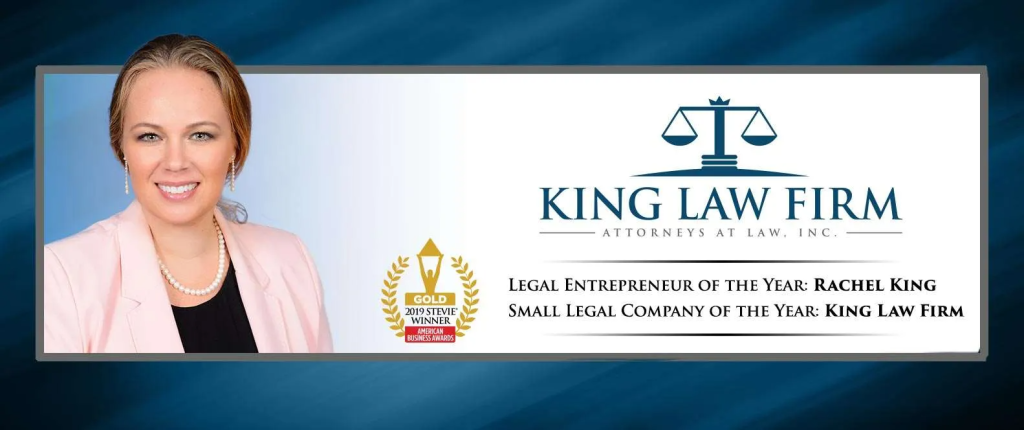
2019 American Business Award® Winners!

I am very pleased to announce that King Law Firm Attorneys at Law, Inc. and I are both recipients of a Gold Stevie® Award from the American Business Awards®. My firm received the top honor in the Small Legal Company of the Year category while I won for Legal Entrepreneur of the Year. Getting to compete with so many wonderful businesses is a great honor, but to win the top prize among the millions of lawyers and thousands of law firms across the nation is both humbling and a total shock. It is truly a tribute to our wonderful clients, our incredible community and of course the best staff around! The American Business Awards® are nicknamed the Stevies® for the Greek word, “Crowned.” They have several different competitions and receive over 12,000 entries every year. Not only that, but over 200 leading entrepreneurs, executives and innovators participate as judges every year. Here is what a couple of the judges had to say: “King Law Firm accomplished so much in just one year. The collaborative approach is vital and the new focus on Immigration law makes so much sense. What really stands out is commitment to the community and helping others... while also doubling revenue.” “I believe that Rachel has shown true leadership and what it means to truly open a business. She served this country very honorably helps out a lot of the surrounding community with her talents and services. She only started her company with $1,800, which is what the true American dream is.” King Law Firm and Rachel King Win Gold ABA Stevie Awards It has been a long, hard road to get to where I am today; being honored on a national level like this makes all of the hard work and struggles well worth it. To learn more about the American Business Awards®, visit https://stevieawards.com/aba. Go to http://stevieawards.com/aba/watch-awards-presentations-live if you would like to view the 2019 award ceremony live on June 11, 2019. Click here to read our full Press Release!

Diplomatic Divorce Amicable Uncontested

Achieving a Diplomatic Divorce

You probably already know this, but divorce is never easy. Despite what you see in films and television, love and marriage aren’t always forever, and very rarely is a divorce a mutual endeavor. One side is inevitably going to be hurt by the other’s decision to leave. This does not mean, however, that a divorce has to be contentious. Anger, resentment and grief are all acceptable emotions when learning your spouse wishes to end your relationship; having the strength to manage these feelings in a courteous and objective manner can go a long way in diplomatically ending your marriage and moving forward with respect and dignity. What is a Diplomatic Divorce? A diplomatic divorce is an amicable divorce in which both parties agree to negotiate in good faith and without malice, coming to reasonable terms for child and spousal support, and division of assets without having to face a judge. This is also known as an uncontested divorce. What You Should Know When Beginning a Diplomatic Divorce Never focus on who may or may not be at fault; this is irrelevant. Placing blame or punishing your spouse will simply lead to additional anger and resentment. Instead, treat your divorce as a business traction — You had signed a contract to build a life together and now one partner wants to leave the company. This will help you focus on the positive as opposed to the negative. Figure out what is most important to you (not everyone around you) and set realistic goals and expectations with your spouse. Try not to squabble over semantics; if your spouse pushes buttons, take time to breathe before answering. Reasonable disagreements will occur; how you handle these disagreements is what will define whether the divorce is amicable or contentious. If you have children, keeping the proceedings civil will help them become more accustomed to their new lifestyle. It also allows for much more bearable custody arrangements. Being diplomatic and respectful does not mean that you and your spouse will ever be friends, nor does it mean you have to like the decision. It simply means you understand your spouse’s decision and love them enough to let them leave peacefully. It also does not mean you won’t feel hurt or need time to grieve. Moving forward amicably allows for a much quicker resolution and reduces the amount of time, stress and money that you must pour into the divorce. Some parties may wish to have a pro se divorce, which means each party handles all paperwork and arguments in a fair and amenable manner; others may need to acquire lawyers to handle all of the communication between the parties. Either way is perfectly acceptable. If you choose pro se, decide if you would like, or are required, to have a mediator to help resolve issues fairly; if you choose to hire attorneys, make sure both of them understand you want to end the marriage quickly, peacefully and amicably.

Luke Perry Remember Actor Activist Heartthrob

Luke Perry – Remembering the Actor and Advocate

The bad-boy persona; the sensitive soul; the smoldering eyes; and that hair. In 1990, Luke Perry quickly became the definition of heartthrob when he rose to stardom in the wildly popular television series Beverly Hills 90210 as broody teen Dylan McKay. (Little known fact: he originally auditioned for the role of Steve Sanders, which he lost to Ian Ziering.) What set Perry apart from many other rising stars at the time, though, was his innate humbleness. Born Coy Luther Perry III in 1966 to Ann and Coy Luther Jr. (and eventually raised by stepfather, Steve Bennett, to whom Perry attributes his kindness and respect), Perry’s small-town roots never allowed his idol status to go to his head. “I don’t change who I am for what I am doing,” he said in a 1992 interview. This sense of self was perhaps the reason for his longevity in the industry. Long after his pinup status faded upon his departure from the show half-way through its 10-year run, Perry still embraced the connection many fans held for the character that made him the envy of every teenage girl. “You know, it doesn't bother me,” he said in an interview with NBC News in 2012. “Always seems to me without one, probably wouldn't have had any of the other, you know? If not for 90210, the rest of the stuff may or may not have happened.” Known mostly for his roles on television, including guest stints on Criminal Minds, Will & Grace, The Simpsons, and Oz, as well as starring roles in Windfall, Jeremiah and most recently, the hit CW series, Riverdale, Perry also appeared or starred in over 30 films, including cult classics Buffy the Vampire Slayer and The Fifth Element. The most important film for Perry, though, had to be John Avildson’s 8 Seconds, which Perry also produced in order to maintain the integrity of the story behind champion bull rider Lane Frost. Outside of acting, Perry was a devoted father and advocate for colorectal cancer. After a colonoscopy revealed pre-cancerous growths in 2015, he became involved with Fight CRC. Together with Chad Schrank, whose wife is a stage III cancer survivor, Perry produced multiple PSAs, including this special video for One Million Strong. On February 27, the day FOX announced a revival of 90210, Perry suffered a massive ischemic stroke. He remained in the hospital until suffering a second stroke that would end his life on March 4 th. He was surrounded by his family and close friends. “Luke was everything you would hope he would be: an incredibly caring, consummate professional with a giant heart, and a true friend to all,” said the producers of Riverdale. “A father figure and mentor to the show’s young cast, Luke was incredibly generous, and he infused the set with love and kindness.”

USCIS EB-5 Program for Foreign Investors and Immigrants

Understanding the EB-5 Program

With the current situation at the Southern border hurting the prospect of asylum requests, and other immigration options taking up to ten years to process, a foreigner who feels persecuted or whose current living situation could be greatly enhanced if they had access to the resources the United States has to offer, can become extremely frustrated and discouraged. However, a lesser-known option, known as the EB-5 program, offers individuals the chance to bypass all the rigmarole and earn lawful permanent residency within two to three years. The EB-5 Program (or Employment-Based fifth preference) was set up in 1990 to allow foreign nationals to become lawful permanent residents by investing capital in qualifying commercial enterprises and stimulate the economy. Investments made through the program must be a minimum of $1,000,000 unless invested through a regional center — entities managed by third-parties centered in and around targeted employment areas (TEA), including impoverished communities and rural areas with high unemployment — at which point, the minimum investment is lowered to $500,000. In order to be approved, an investor must show they are using at-risk funds based on current capital and assets (no loans or illegitimate funds) and prove they will be able to create full-time jobs for at least ten U.S. citizens within two years. There are other regulations currently in place, the biggest of which is the requirement that investors engage in day-to-day management of the businesses (with the exception of passive investors who have invested in regional centers). Currently, there are 10,000 visas available per year and each country is only allowed up to 7% of those visas. Provisions allow family members to be counted as part of this 10,000 limit. As of February 15, 2019, President Trump has officially signed a bill to fund the program through the end of September with no alterations, but due to concerns that the program is riddled with fraud, officials are calling for major reforms that include: Raising the minimum investment from $500,000 to $1.35 million, and $1,000,000 to $1.8 million to account for inflation; No longer counting family members as part of the 10,000 Visa cap and removing the per-country cap; Termination of Regional Centers that fail to promote economic growth; Fixing loopholes in the regional centers that allow funds to be funneled into richer areas; Eliminating passive investments (all investors would be required to manage their businesses on a day-to-day basis). To be considered for the EB-5 program, you must first file Form I-526 — Immigrant Petition by Alien Entrepreneur with the U.S. Citizenship and Immigration Services (USCIS). Because the application process is extremely arduous and paper heavy, it is best to hire a good immigration attorney to put together petition paperwork, prepare for the investor interview, establish lawful permanent residency, and keep the investor appraised of any changes that may occur as legislation continues to update regulations and make changes to the program. Visit the USCIS website for additional information.

Learn about the new 2019 laws in California

New California Laws in 2019

Let’s be clear: plastic straws have not been outlawed in California. However, as of January 1, 2019, restaurants (with the exception of fast food) may not provide you with a plastic straw unless you specifically ask for one. In addition, all restaurants must provide a healthy drink, such as milk or water, as the default beverage in a child meal. As usual, this is just the tip of the iceberg. Below is a list of the laws implemented at the beginning of 2019, categorized by importance to our clients. Small Business Regulations Street vendors are free to sell on California streets, but are subject to regulation if they’re in violation of health, safety or public welfare standards. (Read Bill) Corporate Business Regulations If an employer is required to obtain information about a conviction, or a job applicant would be required to have a firearm, employers may ask the applicant about particular convictions regardless of whether they have been expunged, are sealed, eradicated or dismissed. (Read Bill) Employers may not force any employee to sign a waiver or non-disclosure agreement in order for the employee to be hired, earn a raise or get promoted. (Read Bill) Claimants in sexual harassment suits can choose to keep their name private, while employers may no longer secretly settle or hide factual information in regard to sexual harassment or discrimination claims. (Read Bill) Employees are protected from defamation lawsuits when an allegation of sexual misconduct is based on credible evidence or without malice. (Read Bill) Publicly held corporations must have at least one female on their board of directors by the close of 2019. (Read Bill) Companies must make a reasonable effort to provide a room that is not a bathroom for breastfeeding. (Read Bill) Juvenile Law Minimum age for prosecution in juvenile court is now 12, except in the case of murder or rape. (Read Bill) No child under the age of 16 may be tried as an adult or sent to prison. (Read Bill) Social Policies An “X” will appear on driver licenses for those who do not identify as male or female. (Read Bill) Breeding of cats, dogs and rabbits is now prohibited in pet stores. (Read Bill) Students are free to wear religious and cultural adornments during graduation ceremonies. (Read Bill) Law Enforcement Police must release all body camera footage to the public within 45 days of an assault or death at the hands of an officer. (Read Bill) Anyone convicted of misdemeanor domestic violence is now prohibited from possessing a firearm for life. (Read Bill) Licensed firearm dealers may not sell long guns (rifles or shotguns) to anyone under the age of 21, except when that person is in law enforcement or the military. (Read Bill) Ammunition and bullet drums may now be confiscated along with the weapon. (Read Bill) Personal and Public Safety Gun owners must participate in eight hours of proficiency training prior to receiving a concealed carry license. (Read Bill) Driver’s found guilty of DUI must install a temporary breathalyzer in their car. (Read Bill) If you would like to know more about these, or any laws not listed above, visit California Legislative Information.

 King Law Firm Inc. Fact vs. Fiction: Foster Care, Adoption and the Instant Family

Fact vs. Fiction: Foster Care, Adoption and the Instant Family

There are currently hundreds of thousands of children in the U.S. foster care system. To help shed light on foster care and adoption, director Sean Anders tapped into his own experiences to co-write and direct the new film, Instant Family. There’s a lot you can to take away from the film if you’re considering adopting a child from foster care because most of what happens is grounded in some amount of truth. However, there are still a few things you should know that were left on the cutting room floor for creative reasons. Parenting Classes In the film, before Pete (Mark Wahlberg) and Ellie (Rose Byrne) are even allowed to consider adopting, they must first go through a series of parenting classes. These classes, also known as “pre-service training”, are a requirement in order for prospective parents to learn how to deal with the effects of trauma, integrate children into their family, and form supportive relationships with other parents. What isn’t discussed is licensing. Anyone wishing to foster or adopt must be licensed, and it’s encouraged (or required) by most states that you get duel-licensed in order to foster a child prior to adopting them. The licensing process, which includes an interview, forms and several background checks, can be a bit tedious, which is probably why it was left out of the film. Foster Child Fairs After Pete and Ellie finish their classes, they attend a foster child fair, in which they’re able to meet several children and pick which ones of interest. This may seem to be fictionalized for expediency, but fairs like this do happen, and include games and events that pair adults with children to help them bond. What’s harder to pin down is a requirement to keep siblings together. If Pete and Ellie want to adopt a specific teen, they’re required to take her younger siblings as well. Though social services does recommend that siblings stay together for the health and stability of the children, it’s not clear whether a child can request this as part of their acceptance into a new home. Parent Support Groups Throughout the film, Pete and Ellie are seen in a support group that includes all of the different parents from their classes. Though parents are highly encouraged to attend support groups to discuss their fears and anxieties without judgement, the possibility that it will be with the same couples you were with in pre-service training is highly unlikely, due to scheduling conflicts or other personal matters. Biological Parent Reunification One element of the film that takes some liberties is in the children’s biological mother returning. Pete and Ellie are taken by surprise, but in real life, if there was even a possibility of reunification, this would have been disclosed to them early on, and may have even been part of the deal when taking them. To learn more about foster care and adoption in California, visit the National Foster Care and Adoption Directory Search.

Woman Losing Home After Losing Long-Term Partner

The Truth Behind Probate for Unwed Couples Without a Will or Trust

I’ll take care of it tomorrow. How many times have you said this in the past year? It seems innocuous enough, especially when something is as trivial as mailing a letter or taking out the garbage. But there are some things, such as going to the doctor or planning your retirement, that could have major effects on your life if you continually wait until tomorrow. One of the biggest things many of us put off is drafting a will or putting together a trust. Most people understand that no one is guaranteed a set number of days, however, we also believe we have all the time in the world because nothing bad will ever happen to us. The truth is, life is unpredictable and it’s always better to make sure your loved ones are protected should tomorrow never come. This is especially true for couples who choose to remain unwed. Many believe the fallacy that even if you aren’t married, as long as you’re in a long-term, loving relationship, you’ll still receive all of your partner’s assets in the unlikely event of their death. It comes from the idea of a common-law marriage, wherein anyone living together for over seven years will automatically inherit their partners assets. However, there are only a few states that recognize common-law marriages, and neither California nor Arizona is one of them. In both California and Arizona, the law will always see unmarried couples as separate individuals. No matter how long you may have lived together, unless there is a will or trust that designates you as a beneficiary, only legally married and civil partners may inherit the deceased’s assets. Therefore, if someone were to die without a will or trust, the entire estate would be subject to intestate laws. This means that if you do not already co-own the assets (being a co-signer on a mortgage, having a shared bank account, etc.), all assets that were solely in the deceased’s name must go through intestacy. There are a few things you can do if you are caught in this situation, such as claiming beneficial interest — which is an interest in the economic benefit of the property — or rearrangement of the way the property is shared. In the case of housing, depending on whether you have joint tenancy (in which both parties own equal shares in the property) or Tenants-in-Common (in which each owner has a distinct and separate share in the property), you may have rights of survivorship or will see your partner’s shares divided to other rightful heirs. Bottom line: if you are living with a partner and do not wish to be legally married, make sure to have a will or trust in place. However, if you do happen to find tragedy strike without a will or trust, always seek out the expertise of a licensed attorney to help you navigate through the very complex, stressful and sometimes confusing matters of intestate.

asylum refugees enduring hardships

Hardships Facing Asylum Seekers at the U.S. Border

Who’s gone to the DMV only to have to wait for your number to be called? It’s frustrating, having to sit there for hours on end just to turn in a form or get a new picture taken. It’s even more frustrating when you have an appointment and still have to wait for hours. But what would you think if this wait lasted for weeks, perhaps months, without access to food, water or facilities, and you couldn’t leave because you’d lose your spot if you aren’t there when your number is called? You’d probably be infuriated, perhaps even call it cruel and merciless. It just so happens that is exactly what’s happening right now to refugees seeking asylum at ports of entry on our southern border. Asylum is protection granted to individuals who are unable or unwilling to return to their country out of fear of being persecuted on the basis of race, sex, religion, nationality or political opinion. In accordance with the 1951 Refugee Treaty (which was incorporated into the U.S. Refugee Act of 1980) and the Immigration and Nationality Act (INA), the U.S. has a legal obligation to provide protection to any individual who reaches our border and claims — and qualifies for — asylum. U.S. Customs and Border Protection (CBP) officials are supposed to expedite these claims for anyone safely reaching a port of entry. Yet in recent years, several policies have violated these obligations. One policy in particular, the “turnback” policy, was originally started to reduce abuse of the system (only 20% of claims processed in 2017 were viable) and keep the influx of immigrants at a minimum, but has recently become the new normal, even though it violates both international law (as stated above) and possibly two domestic laws: Title 8 of the U.S. Code, which states non-citizens who arrive in the U.S. by any means have a right to apply for asylum, regardless of citizenship status; and statute 8 U.S.C. 1231(b)(3), which states that a non-citizen may not be deported to a country where their lives and freedoms may be threatened. As part of this policy, the U.S coordinates with Mexican officials to set up camps and implement a metering, or waitlist, system. In Arizona, volunteers have set up camps in which individuals and families are given numbers to wait for an interview with a CBP official. It’s even worse in Texas, as CBP officials are blocking people from even stepping foot on U.S. soil to keep them from being able to claim asylum and telling them to return at a later time. Through President Trump’s zero-tolerance policy (which has recently been terminated), refugees were asked to claim asylum the “right way” through legal ports of entry. But how does this help when they are then turned away, or left to wait in unsafe shelters with very little food and water? Cruel and merciless? We’ll let you decide.

elder abuse restraining orders

Elder Abuse Restraining Orders

We’ve all heard or seen stories of someone obtaining a restraining order because they have been abused in some way and wish to keep someone from coming within a certain distance out of fear for their safety. What we don’t often hear, but is just as prevalent, is elder abuse. According to the National Center on Elder Abuse, one to two million elders in the U.S. suffer from some type of physical, mental or financial abuse. What is elder abuse? Perpetrators of elder abuse may be family members, caregivers and nursing home employees who deprive a person over the age of 65 basic living essentials or cause them physical, financial or mental harm in some way. This may include neglect, abandonment, isolation, abduction or any subsequent behavior that causes the person to feel afraid or controlled. What is an Elder Abuse Restraining Order used for? Many laws have been put in place to protect the elderly from abuse. An Elder Abuse Restraining Order may be filed on the basis of: Personal Conduct, which forbids the person being restrained from abusing, intimidating, stalking, threatening, calling, emailing, texting, or destroying property of the person filing the order; Stay Away, which requires the person being restrained from coming within a certain distance (usually between 50 and 100 yards) of friends, family, caregivers, the residence, work, or other places the person filing the order frequents; or Move-Out, which forces the person being restrained to immediately move out of the home of the person seeking the order. Depending on the type of abuse claimed, the person being restrained may also be forbidden to own and/or purchase a firearm. Who can file an Elder Abuse Restraining Order? If the person being abused is unfit to file the necessary paperwork, the order may be filed by any of the following: a conservator, trustee, guardian, attorney-in-fact, or Guardian ad Litem (someone with a power of attorney or authorization to act on their behalf). What forms need to be filed? To begin the process, the person being abused must fill out form EA-100, the Request for Elder or Dependent Adult Abuse Restraining Order. A declaration of specific past act(s) that have led to harm may also be needed to convince the court that imminent danger is present. Once the restraining order has been issued, the person being restrained must be served the paperwork. Law enforcement can help enforce the restraining order free of charge, but a Proof of Personal Service (CLETS) form ( DV-200) must be filled out by the officer. As always, it’s best to consult with an attorney find out the best options for your particular situation.

property tax reassessment prop 13

Prop 13 and How to Maintain Your Protections

In 1987, your mother purchased her home for $85,000. It’s now 2018 and the home is worth over $500,000. Better yet, it’s about to become yours. The caveat: the transfer of this property will immediately trigger reassessment of the property tax, which means you could end up paying a great deal more than what your mother currently pays. The good news is, there’s a simple way to avoid this reassessment of property tax. Proposition 13, combined with propositions 58 (and 193 for grandparents transferring property to grandchildren with deceased parents), allows for the filing of a simple two-page “Claim for Reassessment for Transfer Between Parent and Child” form with the county assessor’s office in order to waive this reassessment and continue to pay the current tax in accordance with Prop 13 guidelines. In other words, instead of paying property tax based on the current market value of the home (in this example, $500,000), you will continue paying no more than a 2% increase on the original base value of the home (or the original price for which the home was purchased; in this case, $85,000). For this exemption to take effect, you must file the correct form within three years from the date of transfer, or prior to the sale of the home to a third party. If you fail to fill out the form, or you do so after the three-year period, you will be subject to paying the property tax at the current market value for however many years you’ve owned the home prior to filing the paperwork or selling the property. It’s also important to understand that there is no exemption for sibling-to-sibling transfers, which means if you were to decide to sell your mother’s home to your sister, she would not be able to take the exemption. The same goes for a home that was willed to multiple siblings equally, and one wishes to sell their share to another sibling. In this case, the exemption would only apply to your portion of the inheritance, not to the portion you end up purchasing. For more information or to download the correct forms, check out the following links: Claim for Reassessment Exclusion for Transfer Between Parent and Child (Form BOE-58-AH) Claim for Reassessment Exclusion for Transfer from Grandparent to Grandchild (Form BOE-58-G) Riverside County Assesor’s Office Information about Propositions 58 and 193 Information on Reassessment Exemptions You may also contact the following branches of the county assessor for more information: Temecula: 41002 County Center Drive, #230, Temecula, CA 92591-6027; (951) 600- 6200 Hemet: 880 N. State Street, Suite B6, Hemet, CA 92543-1496; (951) 766- 2500 Palm Desert: 38686 El Cerrito Road, Palm Desert, CA 92211; (760) 863-7800 Blythe: 270 N. Broadway, Blythe, CA 92225-1608; (760) 921-5050

actor run production studios

The Business Behind Actor Run Production Studios

Years ago, the mantra for actors was wanting to direct. In the last couple of decades, though, that mantra seems to have transformed into, “I want to produce!” Directing a film is one thing; running a successful business is quite another. Like any business, whether it’s started because of a need in the marketplace, a desire to have independent control, or a want to take risks where another company won’t, there are plenty of things to consider before jumping head first into the deep end. Brad Pitt, Mel Gibson and Adam Sandler have all found success with their respective studios and there are lessons to be learned with each one. The Importance of Ownership Rights When Pitt formed Plan B Entertainment with then wife Jennifer Aniston and Brad Grey in 2001, no one expected their relationships to crumble. But in 2005, Pitt and Aniston divorced, and Grey became CEO of Paramount Pictures, leaving ownership of the company up in the air. Luckily, all three were able to mutually agree upon Pitt taking over full ownership, but not everyone in business is lucky enough to have partners who won’t cause trouble when the relationship fails. Having a strong exit strategy embedded in the contracts when starting a business with a partner, no matter how close they may be, is the smartest way to avoid heavy financial and legal consequences should that partnership eventually fall apart. Financing Your Own Future A lot of businesses use outside funding from investors, banks or other credit institutions to finance some aspect of their businesses. Others, like Gibson, refuse to rely on someone else to build their brand. Gibson used his own finances to form Icon Productions, and to this day, funds the majority of development and packaging costs internally. Sometimes, outside resources are necessary to fund your business, but if you have the opportunity to build your business without investors, banks or other credit institutions, you should take the risk. Staying truly independent is the only way to guarantee your business is the run the way you want, and there’s nothing worse than getting in bed with someone who may not have your best interests at heart. Doing What You Love For any business to be successful, you need to have a passion for what you do and surround yourself with people you enjoy doing business with. In 1999, Adam Sandler formed Happy Madison Productions for no other reason than to have the creative freedom to produce the films he loved. One of the perks, of course, was having the power to keep all of his friends employed. Whether a film was a success or a failure, Sandler clearly has fun producing films with and for those colleagues he admires most. No matter what you want to do, as long as you know what you want, know who you’re getting involved with, and understand the complexities of running a business, success is just one decision away.

Contact Us

Fill out this form below and we'll contact you shortly
*Required Fields